Sunday, 13 March 2016

Homeward Bound

A very mild day, with temperatures reaching a balmy 16 degrees! I again decided to plump for some late afternoon/evening Gulling. The light was not great with a slight heat haze and a faint mist, which made viewing difficult.


A Chiffchaff sang from the end garden along Church Lane, my first singing bird of the year. The fields along Lighthouse Lane again held a number of Pied Wagtails, and Skylarks seemed to be everywhere. Reaching the Lighthouse gardens I suddenly heard a nasally call, which drew my attention to a smart Brambling. It dropped down to feed in the ploughed field, where I found a second bird feeding amongst the Reed Buntings, Linnets and Goldfinch.


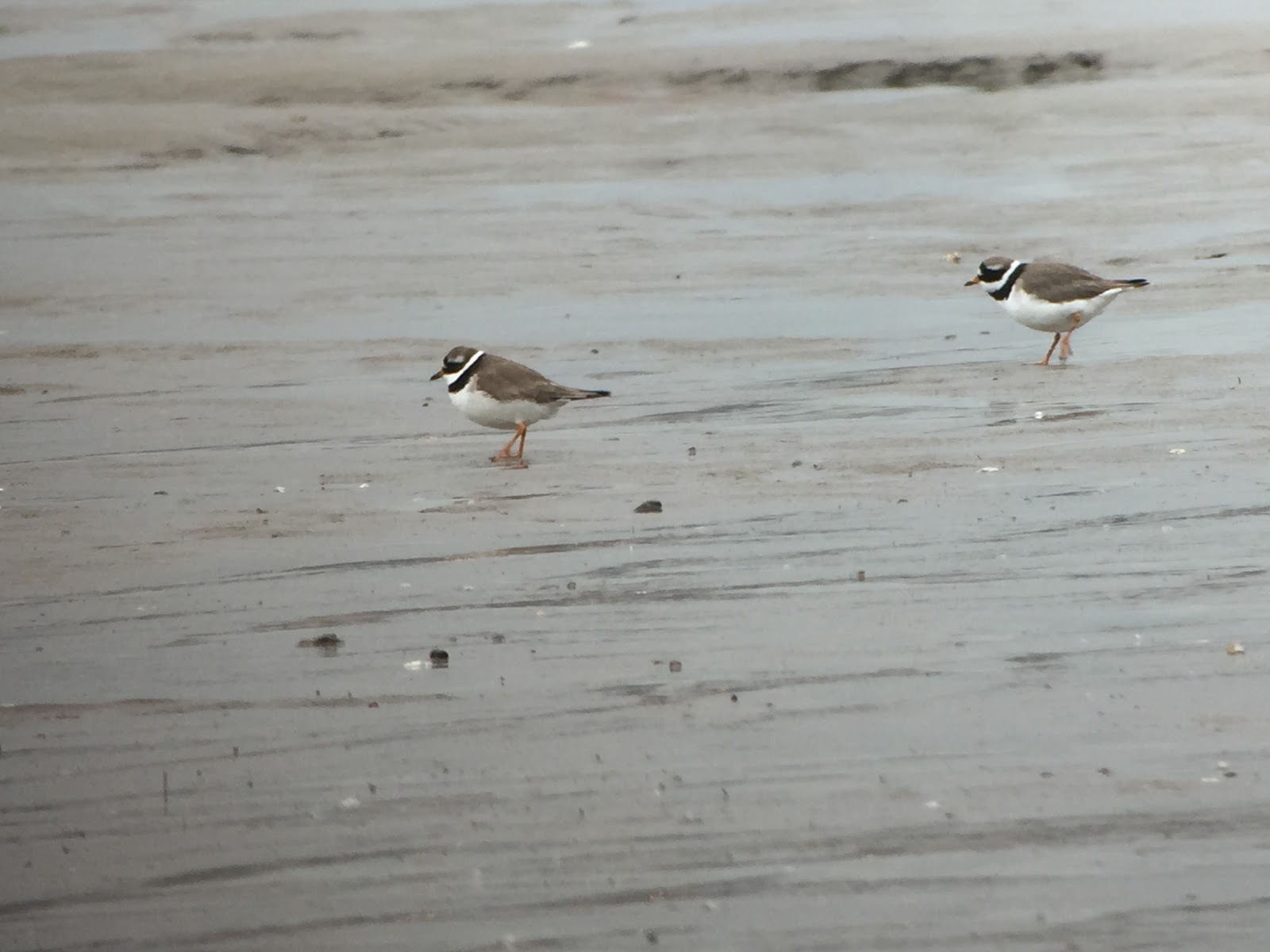
The haze and light mist made scanning Frodsham Score a waste of time, but fortunately the receding tide meant that a few waders were starting to drop in quite close. c.40 Ringed Plover, Grey Plover and c.100 Black tailed Godwit gave some nice views. One of the Godwits had some coloured leg flags, but the light was far from great to read them properly (if anyone has any ideas from the dodgy pics below, please let me know!).


Sean O'Hara joined me shortly after the Godwits had been flushed by some inconsiderate tosser dog owner. I picked up a group of 15 Whooper Swans heading towards us from the Weaver Bend, and they promptly decided to stop off on the Mersey. I presume that this is the Whooper herd from Frodsham Score that are now departing north?


The recent white wingers had encouraged Geoff Bond and a couple of other visiting birders to join Sean and I in tonight's Gulling session. Tonight was not going to be a good night though, with very low numbers of Gulls moving through, and a fraction of the "big" Gull numbers of late. A 3rd winter Yellow Legged Gull was the solitary half-decent Gull during my stay. Having been lulled into a false sense of Spring, I had not prepared myself for how cold it would feel as the sun set. By 6pm I was cold enough to call it a day.....maybe a little too early,as Sean and Geoff had an adult Iceland Gull drop in at 6.15pm.


The walk back to the car produced a few calling Grey Partridge and a flock of c.40 Redwing over Church Lane, but little else. My first non-Iceland visit to the patch in over two weeks, maybe it is time for me to start looking towards Spring migrants rather than concentrating on the Winter stuff still.


Saturday, 12 March 2016

Gulls Glorious Gulls

It was quite mild today, with some broken cloud by the time I headed to patch to meet Paul Kurs. Paul was keen to catch up with Iceland Gull, so I offered to help him with a bit of afternoon Gulling at Hale Lighthouse. Whenever I have birded the patch with Paul, he has always been a bit of a lucky charm, so I was hoping for a bit of the same today.


The weedy field on Lighthouse Lane has finally been ploughed over and now looks primed for the fresh arrivals of Wheatear. Although there were no Wheatears yet, the fields were covered in Pied Wagtails and a single White Wagtail (the first of the year for me). We also managed to pick out a few YellowhammerReed BuntingLinnets and Skylark. Nearing the Lighthouse Paul picked out a redhead Goosander flying east with two Mallards, a great bird to start.


The high tide was starting to recede, so we settled down to have a scan of Frodsham Score and the newly exposed mud. Frank Duff had earlier found a Dark Bellied Brent Goose on the Score, and after a bit I finally picked it up albeit very distantly - a sub-species patchlifer for me! We also picked out a Great White Egret, immature (2cy?) female Marsh Harrier and numerous Ravens. The exposed mud on the Hale side had a couple of Grey Plover, 70+ Dunlin, 30+ Ringed Plover and some nice close views of common bits and pieces.


The Brent Goose decided to have a bit of a fly around the Mersey, moving up towards Ellesmere Port, before swinging back round and dropping onto the edge of the Score. At least we got marginally better views. The number of Gulls were slowly starting to pick up and I picked out a 3rd Winter Yellow Legged Gull, but the "big" Gulls were a lot lower than of late. Mark Garner joined Paul and I for the evenings proceedings, commenting that he was surprised that there weren't more Mediterranean Gulls.....as I picked out a 2nd Summer flying past our position.

  
The sun was just starting to break through the clouds, providing some much better light as the number of "big" Gulls started to move through. I picked up a 1st winter Gull about mid-river heading West. The white head, and small piggy eye immediately got me excited, and the overall multi-tonal upperparts looked good as it drew level with me, finally exposing a lovely white underwing - Caspian Gull. I managed to get Paul and Mark on the bird as it flew away from us and towards the exposed sandbars opposite Ellesmere/Ince Marshes. A well overdue patch lifer, especially given the number that are seen at Richmond Bank.


Patrick Earith and Phil Oddy joined us to continue the Gulling vigil, and it wasn't long before Mark picked up a 2nd winter Iceland Gull flying west. Despite it being distant to start with (probably opposite Pickerings Pasture) it stood out like a sore thumb, and we all got great views as it flew past us. Gull numbers were not as impressive as of late; but with birds coming through at all heights and distances it made it difficult to check all the birds moving West. Paul and Patrick headed off pleased with their respective visits, leaving Mark, Phil and myself to continue watching the ever increasing Gull numbers.


I was scanning very close to the shore when I picked up the same 3rd Winter Iceland Gull from the last few nights, and I even got some half decent (for me) shots of it! This was pretty much the last action of the day for me. Despite Gulls continuing to move through I thought I would head home (like the Iceland Gulls), the talk of food having persuaded me to leave before last light for the first time in quite some time. The walk back to the car was filled with singing Skylark and calls of rather territorial Grey Partridge. Spring is clearly in the air, but the Gulls are hanging on in there and will keep me coming back for at least a week or two.


Friday, 11 March 2016

Once Bittern.....

A much milder day than of late with spring like sunshine (finally!); but by the time I got down to patch the temperature was dropping and the sunshine was a little more hazy. However the conditions still seemed set fair for some decent Gulling.


The fields along Lighthouse Lane appeared more spring like, with singing Skylark, Linnet, Reed Bunting and Grey Partridge and a decent gathering of about 70 Curlew fed in the stubble field. It hopefully won't be too long until the first alba Wagtails and Wheatears start appearing.


Setting myself up on the bench just to the east of the Lighthouse I had a brief scan of Frodsham Score, but it was quiet. The Swan herd was again sitting miles away and the Canada Geese didn't hold anything more interesting than the dodgy white barnyard Geese. I even failed to pick out a single Egret, the first blank visit for quite some time. The Mersey held 2 Avocet close to the outflow at Frodsham, whilst Ringed Plover numbers continue to rise.


I was joined by Mark Garner as I switched my attention to the Gulls that were slowly starting to build. I quickly picked up a 3rd winter Iceland Gull which flew in from the east and settled down in front of us. On closer inspection it looks like the same bird as earlier in the week, with extensive white bleaching into the tertials. Mark is fairly certain that he had seen this bird earlier in the week at Richmond Bank (possibly indicating where the Gulls go during the day).


A 1st winter Yellow Legged Gull put in a brief appearance before disappearing into the mass of Gulls. Mark picked up a second Iceland Gull, this time an adult flying in from the east and again pitching down close to the 3rd winter (even from the rubbish picture below the Iceland still sticks out like a sore thumb).


Despite a good movement of Gulls we failed to locate anything further of interest. The Gulls had initially started moving at a decent height (just over the Mersey), but as the wind dropped birds started moving through at all heights making it difficult. Where on other evenings I was fairly confident I hadn't overlooked too much, tonight was a different proposition - I just hope that I didn't overlook a Franklin's, Ross's or the like!


The only slight distraction from the Gulling was the constant small murmerations moving east to the Runcorn Bridge. The entire structure of the Bridge looked black with Starlings from a distance, and I wouldn't even begin to estimate numbers involved, but it was impressive.


Driving home along Carr Lane I decided to pull in by the flooded field and see whether Iggy's Short Eared Owl was still around. There was still plenty of bird song floating out of the surrounding woodland, and my eye was caught by a few bats floating around. Whilst watching one of the bats (presumably Pipistrelle) I scanned past a large bird flying towards me. It took a few seconds for my brain to connect to my eyes and realise that I was watching a Bittern! Flying in from the direction of Hale Marsh, it landed about 20 meters away from me in probably the smallest clump of reeds on the patch. I have subsequently established that this is only the 3rd record in about 30 years, and the 1st in about 10 years. Fist pumps all round and a cracking piece of patchgold.


Not a bad way to kick start the weekend, and the next patch visit can't come quick enough. Fingers crossed for some good weather and maybe a few early migrants.


Tuesday, 8 March 2016

The Gulling Goes On

The early rain had cleared leaving a milder (finally into double figures again!) overcast afternoon. It was relatively bright and I was hopeful that despite the poor tide times that the Gulling at Hale Shore would be good.


Rob Cockbain had texted me early afternoon to let me know that there was a Green Sandpiper on Carr Lane Pools. Despite a fairly good search I failed to relocate it, but the Pools did hold 158 Teal, single Black Tailed Godwit and 12 Redshank. A Little Grebe in Ramsbrook (the stream by the bridge on Carr Lane) was the first on patch this year, the water levels on Carr Lane Pools are not looking promising for successful breeding this year.


At least three Buzzard were displaying at the back of the fields, but otherwise it was quiet. At least it won't be too long before the first waders start moving through the patch.

Moving on I parked up and walked along Lighthouse Lane. The weedy field and hedgerow held c.35 Reed Bunting, c.7 Yellowhammer, and a few Linnets, Meadow Pipit and Skylark. It was evident that some of the big gulls were starting to move (much earlier than of late), but only small numbers were gathering on the mud/sand banks on the Mersey.


Scanning Frodsham Score I picked up one of the regular Great White Egrets (stalking one of the sheep), 5 Little Egret and c.10 Pink Footed Geese. The Swan herd (totalling 48 birds) had moved a long way west, and were just a little too distant to assign to species. A thorough grilling of the geese failed to locate anything further of interest, but I picked up 2 Avocet on the Mersey in almost the identical spot to the other night. A couple of pairs of Raven made the short trip across the Mersey, possibly birds prospecting for nest sites?


Gull numbers were slowly picking up as Sean O'Hara and Ian Igglesden turned up for tonight's Gulling session. I picked up an adult Iceland Gull on one of the central sandbars, sat nicely in the open. However just as I was about to show Sean the whole group got up and flew towards us; this did at least allow me to pick up a 2nd bird that must have been hiding deeper in the group. I kept watching one of the Iceland's and was able to pick it out as it landed, getting Ian onto the bird (slightly easier at it gave a good wing stretch).


 Gulls by now were starting to flood through with at least 5 Yellow Legged Gulls (2 x adult, 1 x 1st winter, 2 x 3rd winter),  picked out among c.15,000 Herring, c10,000 Lesser Black Backed, c.30,000 Black Headed, c.15,000 Common with smaller numbers of Great Black Backed. Fairly impressive numbers! I picked up a further adult/3rd winter Iceland Gull amongst the Gulls flooding up the Mersey, which dropped into the same group that held the first Iceland of the evening. Gulls were still moving, as the light went and the Grey Partridges made their presence known.

The Gull numbers are remaining high, and I'll no doubt continue watching the Gull roosts for the next couple of weeks. Maybe I'm just being greedy, but I'm hoping that there is still time for one last good Gull before the winter is out.....roll on the next session!


Saturday, 5 March 2016

Last Knockings

It felt a lot milder today, with plenty of sunshine and lighter winds; so I was hopeful that the Gulling tonight would be a slightly more pleasant experience. Meeting Iggy on Lighthouse Lane, the late winter sunshine made the Mersey look golden.


Walking down to the Lighthouse I noticed that the wind was picking up slightly, but the light was good and there already appeared to be a good gathering of Gulls. Grey Partridge seemed to be calling almost continuously from the weedy fields, and a few Reed Buntings and Linnets whizzed around. Setting up east of the Lighthouse, we had a brief scan of the Score and Mersey, picking up 7 Avocet, plenty of Ravens over the Score, and the Starling murmeration just starting to get going.


The clouds by this point were starting to gather, and we both thought that we had dodged the rain as we scanned over towards Weston Point and Frodsham. We were wrong.....but undeterred we continued our vigil. I picked up a 3rd winter Yellow Legged Gull, quickly followed by an adult Iceland Gull which flew in and seemed to pitch almost opposite our position, but we both lost it as it landed. The rain, followed by torrential hail made viewing difficult and we watched a Great White Egret as it struggled to make any headway against the hail and wind. One of us decided to wimp out and shelter at the bottom of the river wall......whilst Ian continued to watch from the top.


I was close to calling it a day as I was drenched, and getting increasingly cold, but Ian managed to convince me to give it another 5 minutes. Fortunately the rain and hail did stop, and revealed a mass of Gulls that presumably were grounded by the weather. I estimated in the region of c.30,000 Black Headed, c.5000 Herring, c.2000 Common, c.1000 Lesser Black Backed and c.300 Great Black Backed. The tide was an hour later than yesterday, and this made a big difference with the Gulls having more space to feed and roost and many of the Gulls using sandbanks and mudflats further way from our position.


I managed to pick out a further 1st winter Iceland Gull, a really milky coloured bird, however again it landed and disappeared. Small groups of Dunlin and Ringed Plover were moving up towards Pickerings, whilst Oystercatcher numbers also seem to be on the rise. The Gulls continued to flood through, but by now the light was fading fast, and the Gulls were all too distant to ID so we called it a night. The walk back to the cars didn't produce too much else, but chat of old twitches was great fun....seems like a lifetime ago. Hopefully we can turn a mega up on patch this year to make up for it.


Friday, 4 March 2016

Friday Gulling

The early snow had given way to cold, damp and windy conditions on patch this afternoon; the tail end of Storm Jake still clearly wagging.


Arriving a little early for Gulling I decided again to head to Hale Shore to look for the recent flock of Twite. Climbing down the river wall to the shore I had a quick scan of the Mersey, and was pleased to see that Ringed Plover and Dunlin numbers were continuing to build - at least a tenuous link to Spring!


The murk again made scanning Frodsham Score difficult, although I did succeed in picking out a Great White Egret on the very edge of the score. There were large numbers of Wigeon feeding just below the Score banks, and a few Pink Footed Geese were visible in the Canada Goose flock, but otherwise the drizzle made it hard work.


Continuing along the shore to Within Way I flushed roughly 21 Common Snipe and a single Jack Snipe, along with 4 Rock Pipit (all of which appeared to be nominate petrosus - including one exceedingly dark bird). I'm always surprised to see Grey Partridge on the shore, and today was no different with at least 10 birds flushed from the damp reedy ground. A further Great White Egret flew east past my position, and a further quick scan of the Score picked up roughly 20 Raven.


I had initially thought that I would try Gulling from the end of Within Way, especially given Bill Morton's success with 3 adult Iceland Gulls last night from Frodsham. However the wind and drizzle were just a bit too much for the exposed position, so I looped back towards the Lighthouse. Finding a slightly more sheltered position I started to scan the Mersey again, and quickly picked up two yearticks. The first a smart male Goldeneye flying east upriver and towards Pickerings, and then a group of 5 Avocet that flew in and pitched in the gutter by the outflow over at Frodsham.


I was joined by Ian Igglesden for the Gulling, he even managed to find some washed up oil drums for us to sit on to make the scanning slightly more comfortable. The gull numbers were lower than of late, the tide and wind again appearing to have an impact on location and numbers. However we persevered and quickly picked up a 2nd winter Mediterranean Gull and 2 adult Iceland Gulls, along with a couple of Yellow Legged Gull (3rd winter and adult). Ian picked up yet another Great White Egret flying east, the third of the day and by far the closest. I then picked up a very interesting looking gull, which superficially looked like an Iceland Gull. The bill appeared washed out (greenish, and appeared slightly more heavy than the other Iceland's); the primary projection was shorter, and the outer primaries were a darkish grey. Everything seemed to point towards a Kumlien's! I managed to get Ian onto the bird and we attempted to get some more views. Sadly we weren't able to pick it out again in the gathering darkness, probably not helped by my near stumble of excitement from my oil drum! Hopefully we'll pick it up again in the roost again and get a more definitive ID.   
 
 
By now the light had almost entirely gone, so we both headed back to the cars listening to Grey Partridge and talking about birding in warmer climes. Roll on the next Gulling session....maybe I don't want Spring to come along just yet!

Monday, 29 February 2016

Last Leap of the Month

Due to family commitments I wasn't able to get out on Sunday, and it was frustrating to hear that 7 Twite were found east of the Lighthouse. Twite are an exceedingly good bird for the patch, so I was keen to try and get down as soon as possible to see if I could find them. Thankfully with the lighter evenings I was able to head down for a couple of hours after work today.


By the time I reached the end of Church Road the drizzle was horizontal, and the cold easterly really didn't make it feel too pleasant. A Sparrowhawk shot across the gravel track down to the Lighthouse, whilst the weedy field held a good group of Curlew, Starling and a small number of Linnet. A female Merlin whizzed through, disturbing the Linnet flock and flushing a mix of Reed Bunting, Yellowhammer, Meadow Pipit and Skylark.


Climbing down the river wall I walked the entire length of Hale Shore from the Lighthouse to Within Way. I really should have learnt by now to wear some proper footwear because the time I reached Within Way my feet were rather cold and wet. I managed to flush 4 Rock Pipit, 5 Common Snipe, 17 Grey Partridge and a few groups of Linnets and Goldfinch, but I failed to locate any Twite. The fields didn't hold much on the return walk, but a few Grey Partridge were calling and showing fairly well.


Scanning the Mersey from by the Lighthouse I was startled by a smart male Merlin that nearly took my head off. The river was quiet and only held a pair of Great Crested Grebe, and a few small rafts of Gulls. The murk made picking out anything on Frodsham Score difficult (no chance of picking up the possible Brents seen yesterday!), but a couple of Little Egrets stalked the outer edges, whilst the Whooper Swans at least stood out like beacons. A couple of Ravens were being tossed around in the wind, and a Peregrine towered over the back of the Score, but I'll have to wait for a clearer day before attempting any further patch theft.

 
I settled into a sheltered spot under the Lighthouse in preparation for some gullings, but there was a stark difference to Saturdays gull fest with only a handful of Black Heads and Lesser Black Backed present on the exposed mud. There seemed to be a larger congregation down towards Ince Marshes/Ellesmere Port, presumably due to tide height and winds. However from around 5pm Gulls starting to stream down the Mersey with many at mid-channel distance and low of the water, which actually made ID easier.

To start with the majority of gulls moving were Black Heads and Common, with a single 1st winter Mediterranean Gull picked out. But from about 5.15pm the larger gulls started to move, with good numbers of both Herring-types and Lesser Black Backed. At 5.27pm I picked up a 1st winter Iceland Gull, which brings the Iceland total to 5 birds over the last couple of days. Larger gulls continued to pour through and at about 5.35pm I picked up a 3rd winter/adult type Iceland Gull,  on closer inspection it appeared to show greyer edging to the primaries (roughly P1-P3), however it continued flying away and I failed to get any further salient features. Gulls continued to pour through until I left, but having lost all feeling in my cold damp toes I decided to head home....hopefully the trench foot won't hold me back in March!