Sunday, 30 October 2016

Plenty of Chat

After a busy weekend with next to no birding, I decided to take a couple of days annual leave to get out and about on patch again. Monday was a rather cold and grey day, with a light to moderate easterly breeze. It certainly felt like the end of autumn, but I was still hopeful that there may be a few bits lurking away.


As ever I started at the flooded field along Carr Lane, where a single Black Tailed Godwit was feeding among the Eurasian Teal and Moorhen. A single Common Snipe was sneaking around in the less dense areas of cover, but made a quick exit as a Sparrowhawk made a low approach across the field.


Moving round to the gate on Town Lane I had a good scan of the c.400 Black Headed Gull that were present. Sadly I couldn't find anything of greater interest than a single yellow darvic ringed bird (which was sadly just too far away to read). 3 Black Tailed Godwit, 6 Common Snipe, c.120 Eurasian Teal, 48 Wigeon, 9 Shoveler, 2 Gadwall were feeding across the Pools, whilst a Kestrel kept a watchful eye on proceedings. Scanning over towards the wet fields along Town Lane I picked up a distant Stonechat so decided to walk along.


Walking up to the bridge on Town Lane I picked up a minimum of 6 Stonechat across Hale Marsh and Carr Lane. Despite a good check of all of the birds they all appeared to be of the nominate hibernans race. A female Merlin dashed through, causing panic among the Meadow Pipits, Linnets and Goldfinch on Hale Marsh. At least 4 Little Egret were feeding across the area, whilst a Peregrine glided over heading towards Pickerings.


Within Way was relatively quiet, with the gardens at the very top and the area around the farm appearing most productive, with a few Nuthatch, Siskin and Lesser Redpoll buzzing around. The fields held a few Curlew, Grey Partridge and a few Redwing and Fieldfare but it seemed very quiet. A further Peregrine drifted over as I headed down to the Mersey, whilst a few small groups of Meadow Pipit were moving overhead. I eventually came across a small mixed Tit flock along the hedge at the bottom of Within Way, with c.20 Long Tailed Tit, 12 Blue Tit, 3 Great Tit and 2 Goldcrest but sadly nothing rarer.


The tide was pretty much at it's lowest point when I reached the end of Within Way, and the rocks contained a few Wigeon, Eurasian Teal and a single Little Egret. There were good numbers of waders towards Pickerings Pasture, including c.400 Golden Plover, however many were too distant to do much with. A couple more Stonechat were on the corner of Hale Marsh, whilst 2 littoralis Rock Pipit gave some unusually good views.


I had a really good kick around in the edges of the fields and the tideline of the Mersey with very few results. c.150 Goldfinch gave some good views, along with another 3 Stonechat, but other than a few more Rock Pipits and a handful of Meadow Pipits it was very quiet. I normally like mid-week birding on patch due to the lack of disturbance from walkers, but strangely it seemed very quiet. I continued along the shore towards the Lighthouse checking all of the bushes, thickets, damp areas with no joy.


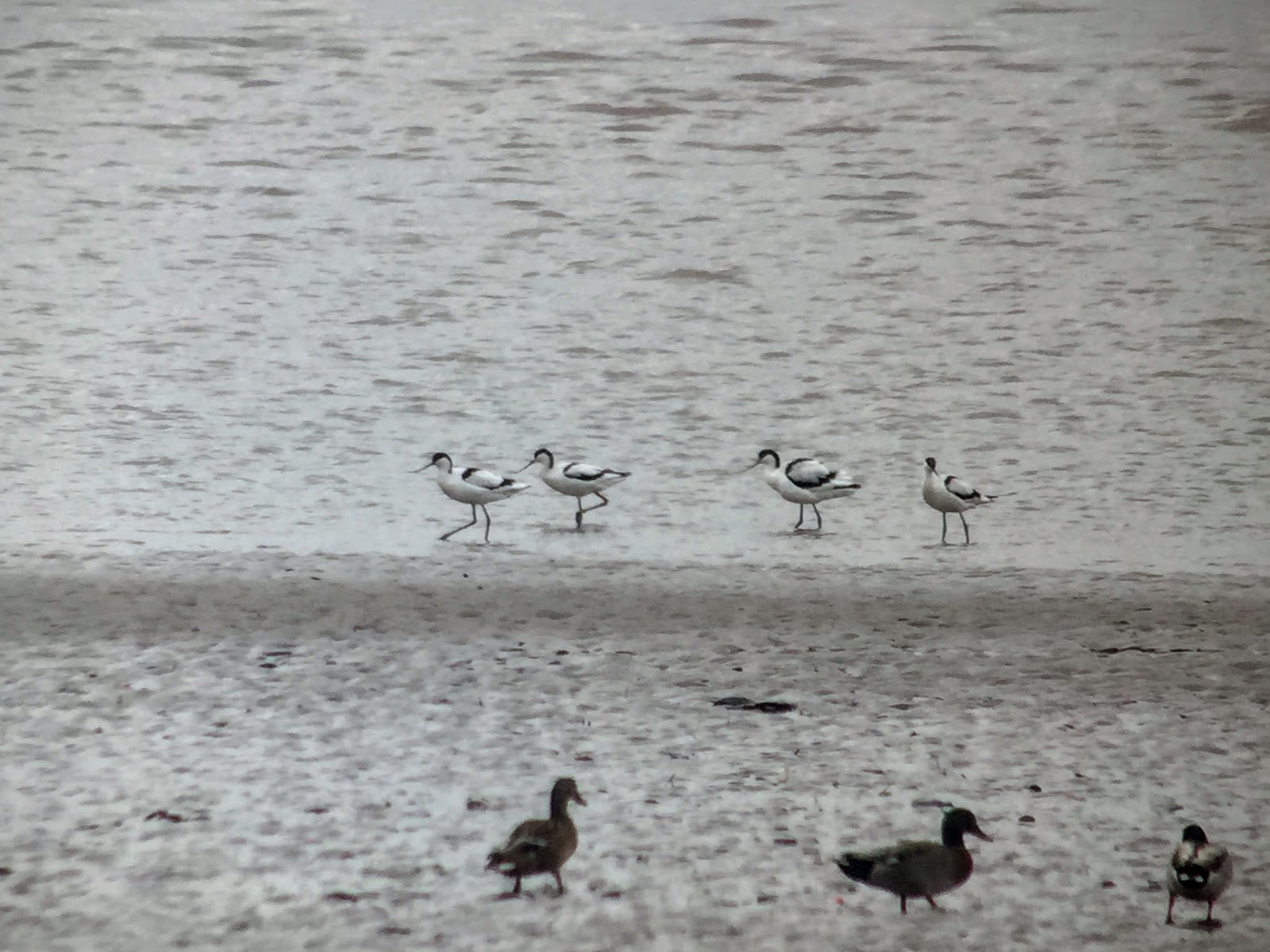
Fortunately the last section before the Lighthouse provided a bit of light relief. A male Pochard (my first within patch boundaries not stolen, sorry, borrowed from the Frodsham side) was mooching with the local Mallard flock. 4 Avocet dropped in and fed along the shoreline, my first in a number of months. Scanning Frodsham Score and Ince Marshes resulted in only a single Great White Egret among 9 Little Egret. An exceedingly distant small egret feeding among the cattle had me guessing for quite some time, but eventually gave itself up as a Little - surely only a matter of time though with at least 9-10 birds close by.


The walk back to the car along Lighthouse Lane and Church Lane was very slow, with only a few Grey Partridge, a Great Spotted Woodpecker and a Sparrowhawk causing me to slow down and stop. October seems to be fizzling out a little on patch, and with no decent looking weather on the horizon it could be a slow last few days of the month. 


Sunday, 23 October 2016

Catch the Pigeon

I wasn't going to have any real chance to get out onto patch this weekend, so I ensured I was up early to get some vizmig in first thing. The forecast didn't look too promising, from a vizmig perspective but at least it was correct for once. A cold start but with generally bright conditions and broken clouds; the wind remained a light ENE throughout my visit.


I arrived on Carr Lane just as the first traces of light were filling the sky. A Little Owl was yelping from towards Great Boar Wood, an unusual location that I have not heard them from. The flooded field held a good number of Eurasian Teal and a single female Mallard. A Water Rail started squealing as my car door slammed shut (note to self, great for waking up Rails, but not great for flushing every duck on the pool!). On closer inspection there were still a few Common Snipe left, whilst a Jack Snipe was bobbing away in the open (although sadly too dark for pics).


Moving round to Church Lane I met Rob Cockbain who had just had a Short Eared Owl hunting along the hedge towards the Mersey, but sadly it didn't decide to reappear. Over the next two hours we had a reasonable movement of birds with 6531 birds of 26 species. The biggest mover by quite some way were Woodpigeon, with 5495 seen including some seriously big flocks. We were joined by Jeff Clark and one of his birdwatching classes, who clearly enjoyed the spectacle.


The other highlights included 217 Fieldfare, 201 Redwing, 8 Tree Sparrow, 10 Brambling and 10 Siskin. The big surprise was the large numbers of Jackdaw on the move, with 234 moving south east over our position. There were very few other distractions from the vizmig with only a single Kestrel, Sparrowhawk and Common Buzzard. The end garden held a few Goldcrest among the mixed flocks, but it had a real "end of Autumn" feel.


A brief walk down to Hale Lighthouse was uneventful with the fields seemingly very quiet with only the odd Skylark and Meadow Pipit. Buntings seem to be in very short supply with only 5 Reed Bunting and a single Yellowhammer. The Mersey had a good covering of waders and gulls, but nothing jumped out during a brief scan. Even Frodsham Score and Ince Marshes seemed quiet, with not even a single Egret on show!? With time running out I headed back to the car so that I could have a quick stop at Carr Lane on the way home.


The light was great at the flooded field, but sadly there wasn't much present. A single Black Tailed Godwit had joined a small group of Eurasian Teal, Moorhen and a single Common Snipe. Carr Lane Pools looked nearly as quiet, although a single Pintail and 3 Gadwall were hiding amongst the Eurasian Teal.

A relatively slow patch visit, but still some enjoyable birding; saying that it certainly felt like the beginning of the end of the Autumn birding......I seriously hope I'm wrong and there is still time for a few more bits.


Wednesday, 19 October 2016

Gull, Gull, Gull, Gull......Gannet!!

Having neglected the patch at the weekend (in favour of some dirty twitching) I decided to take a days annual leave having looked at the weather and tide forecasts. The early morning torrential rain had eased by the time I headed out, and with strengthening WNW'lies, squally showers and a monster high tide forecast I was hopeful that something would get blown onto patch.


My stop at the flooded field along Carr Lane luckily coincided with a rather torrential shower. There were good numbers of Eurasian Teal, a single Gadwall and 2 Common Snipe on a quick scan of the area, but the heavy rain had me jumping back into the car for shelter. I had a brief scan of Carr Lane Pools from the car, but other than a selection of the expected ducks and a single Ruff there was nothing to lure me out of my car.


I was not overly hopeful that there would be many passerines around when I reached Hale Park, but was pleasantly surprised to find a Yellow-browed Warbler calling as soon as I opened the car door. I managed a few brief views of the bird as it fed among the canopy of the Sycamores, among a decent selection of Goldcrest, Long-tailed Tit, Coal Tit, Nuthatch and the more expected bits. Walking the edge of the park was fairly unproductive, with the wind making it difficult to see, let along hear anything. Heading into the main section of Hale Park revealed good numbers (although not to Spurn standards) of Goldcrest and a single Chiffchaff, whilst Treecreeper and Nuthatch were in much evidence. I flushed a Woodcock from almost beneath my feet by the gate entrance to the old football pitch (clearly I wasn't looking hard enough, annoying as it would have provided nice views on the deck).


I spent the next hour trudging around the wet fields, rough scrubby areas, cut stubble and carrot fields with very little success. I managed to kick out a few Meadow Pipit and Skylark, whilst a small covey of Grey Partridge startled me for a moment! Even the vizmig was poor, with the winds clearly putting any potential migrants off. Reaching the wet area by the wooden bridge I flushed a couple of Common Snipe, followed by a Jack Snipe that shot up and headed straight back down onto the Shore behind me. 


Walking Hale Shore was just as unproductive with only a handful of Meadow Pipit and 2 Skylark. A couple of Stonechat tried to lift my spirits, and one of the male birds perched up nicely for some pics. By now the tide was rushing in and I decided to find a sheltered spot to view the river from. Walking c.50 yards west of the wooden bridge I found a sheltered area, which at least provided a break from the wind (if not the rain).


After a few fruitless scans of the Mersey I lifted my head up from the scope and used my bins to look at a few birds heading west about mid-channel but above the treeline. The first couple were Lesser-black backed Gulls, followed by a Common Gull, followed by another Lesser-black Backed, followed by.......a GANNET! I couldn't quite believe my eyes as I took a double take of the sub-adult Gannet heading west. Fortunately I managed to fire off a few pics (which just about exclude a Boeing 747), before I lost it behind the bush. My first patch record, and the first for a number of years (most of the records from Frodsham have involved dead/moribund individuals).


My expectation levels had clearly been raised far too much as over the next 4 hours I failed to pick up another seaduck, auk, diver or seabird. However the big high tide (forecast as 8.9m, but appeared to be well over 9m) did produce a few highlights. The flooded Ince Marshes/Gowy Gutter revealed at least 5 Great White Egret, along with a minimum of 24 Little Egret. Ravens were everywhere, whilst a juvenile Marsh Harrier ventured out onto the edges of the marsh. Wigeon number appear to be building nicely and there were c.300 birds being pushed around by the tide. Waders were moving around constantly, but not in great numbers - clearly they had found a drier area to roost?


Heading back to the car through Hale Park was uneventful, though a nice group of 6 Lesser Redpoll were feeding in the weedy field opposite the farm. The wind by now was exceedingly strong and trying to hear anything was near impossible, a single Blackcap and a Chiffchaff were the highlights of a quiet walk back.


I decided to head round to check the Mersey from the end of Church Lane (hoping the height may help), but despite a further half hour scan I failed to pick up any seabirds....or anything else of note for that matter! Hopefully with further NW'lies forecast from the 27th, there is still a good chance of something being blown down onto patch. Sadly I think the Leaches Petrel "window" has firmly shut for another year (where have all of the September NW'lies gone over the last few years?!?!).


A brief stop on the bridge at Town Lane revealed a good number of Pied Wagtail and Meadow Pipit, along with a single Grey Wagtail feeding in the drier areas (of a rather flooded Hale Marsh). At least 6 Little Egret were feeding across the Marsh, whilst a Peregrine was sat on the edge of the decoy. A scan of the gulls produced a 2nd winter Mediterranean Gull, but the onset of another very heavy downpour made me think twice about getting out of the car. I was already cold, wet and tired so with the rain seeming to be fairly set in I headed home.


Dirty Twitching

It had been over 18 months since my last twitch and British lifer (the Derbyshire Red-throated Pipit) having been restricted to mostly patch birding due to family and work commitments. Not that I had really missed twitching (despite being stuck on 449 species!); I had fallen in love with patch birding over the last few years. That all changed on Thursday 13th October when news came out of a Siberian Accentor at Spurn, one of those near-mythical Sibes that dreams are made of.....but with work and family commitments I wasn't able to make it over until Sunday! Argghhh!


Fortunately it decided to stick around and went to roost on Saturday evening following it's usual pattern. I quickly made plans to pick up Iggy and head over to Spurn for first light. The drive over was painful, with clear skies prompting fears of an overnight departure. A Woodcock sat on the road was the only highlight of the drive over to Spurn. Reaching Easington we were greeted with news that the Accentor was still present (clearly my prayers had been answered). The hedges around the field held shed loads of Tree Sparrow, Fieldfare and Redwing, whilst Goldcrest seemed to be bouncing around everywhere. The short walk to the old school resulted in a brief snippet of Firecrest, Siskin and Lesser Redpolls moving over, but there was no waiting around!


Fortunately there was no queue and I was able to join the viewing area straight away. I was amazed to see the Siberian Accentor straight away, and not a distant dot but mooching around no more than 10 meters away! WOW! WHAT. A. BIRD! What else can I say? I took some quick shaky pics, but mostly enjoyed just watching the bird feeding away through the scope, catching a few snippets of quiet "Dunnock-like" chattering. Having composed myself and returned my jaw to my upper mandible  I took time to get some more pics.


I was amazed at how confiding it was, but mostly I just couldn't stop smiling. My 450th British species, and what a way to bring it up. Aside from the Siberian Accentor the whole area was swarming with Goldcrest, 3-4 Chiffchaff whilst Siskin, Lesser Redpoll and Brambling were constantly moving overhead. Having spent about an hour with the Accentor we decided to head down towards the Crown and Anchor and catch up with some of the other Scarcities that were about.


We arrived just at the right time as the Radde's Warbler had just been reported at the north end of the Canal Zone. Parking up we wandered around, kicking up a few Robins and Goldcrest from beneath our feet! Brent Geese and a fine selection of waders were feeding on the Humber as we reached the huddle of birders staring at the bushes where the Radde's Warbler had last been seen. Almost immediately the Radde's Warbler started to call in front of us, and I quickly picked it up working along the hedge/grass line. We got some superb views, and it was great to listen to the call (in person) again - a softer "tchak" compared to the rather harsh "tak" of Dusky.


A familiar "ping" from above us alerted us to 3 Bearded Tit flying high south, always great to see post-breeding birds dispersing. We decided to carry on and do a loop around the Canal Zone and head to the Blue Bell CafĂ©. The whole area was swarming with Goldcrests, Meadow Pipits and Robins and a mix of Thrushes moving over, but sadly we couldn't find anything rarer. As we walked towards the Blue Bell the first rain started to pelt down, but we decided to head on and have a look at the Shorelark that had taken up residence. 


Shorelark (pic 3 courtesy and copyright of Ian Igglesden)

Although I used to see Shorelark regularly in Suffolk, I haven't seen one for a number of years. I had forgotten how smart they are! It was remarkably confiding and allowed some nice pics (for me). The rain was really starting to pelt it down now as we headed back towards the Crown and Anchor. We decided to shelter in Kilnsea Churchyard, hopeful that something decent may think the same. After a long birdless wait (other than a few wet and windblown Blackcap and Chiffchaff) we decided to just get wet and wandered round to the car park at the Crown and Anchor. After a short wait I picked up a very smart Mealy Redpoll among a group of Siskin. Getting Iggy onto the bird as small Phyllosc flew into the same bush....a Pallas's Warbler. We managed to get the small group of birders onto it before it flew into the roadside hedge. Again, this was my first Pallas's since I moved back to Liverpool - what cracking little birds!


Tundra Bean Geese (all pics courtesy and copyright of Ian Igglesden)

As we were totally drenched we decided to have a quick look for the Tundra Bean Geese that were north of Kilnsea Wetland. Despite a few blank looking faces in the car park, we quickly located them in the field from the road. There was no sign of any Taiga , despite news services reporting to the contrary?! The fields were full of Golden Plover, Starling and Thrushes, whilst Meadow Pipits and Skylark bounced around in the rain. Returning to the car we stumbled across a stunning male Redstart sat on the fenceposts, whilst a few Chiffchaff were hopping around looking rather bedraggled.


With rain forecast well into the afternoon we (well I) decided to head to Alkborough to try and catch up with the Western Purple Swamphen (I had so far resisted the urge to head over for the plastic purple chicken!!). By the time we arrived the rain had cleared and left behind a beautiful bright sunny afternoon. What a cracking little reserve this is! Cetti's Warbler and Bearded Tits were calling from the reedbeds, whilst at least 5 Marsh Harrier were quartering the same area.


We spent he next couple of hours scanning the edges of the Pools without success, but enjoyed a really good selection of waders including Avocets, 2 Greenshank, 2 Green Sandpiper, 7 Ruff, Spotted Redshank, 60+ Common Snipe and plenty of Dunlin, Redshank, Black Tailed Godwit. A Great Spotted Woodpecker and Nuthatch joined a few typical woodland birds, and a single Chiffchaff crept through behind our position. Time was marching on, and we decided to call it quits and head back to Liverpool....too soon by the sounds as the Swampdonkey was reported about 30 minutes after we left! Ah well, one to pop back for next week when I'm back in the area.......if I can really be bothered?! 

A great days birding, and it felt amazing to be back on the east coast. The number of common passerines and migrants reminded me just what I had left behind when I moved to Liverpool. Then again it makes visits back to places like Spurn even more magical. I'm just hoping that the (surely) imminent Hawk Owl turns up whilst the birding is still so good..........